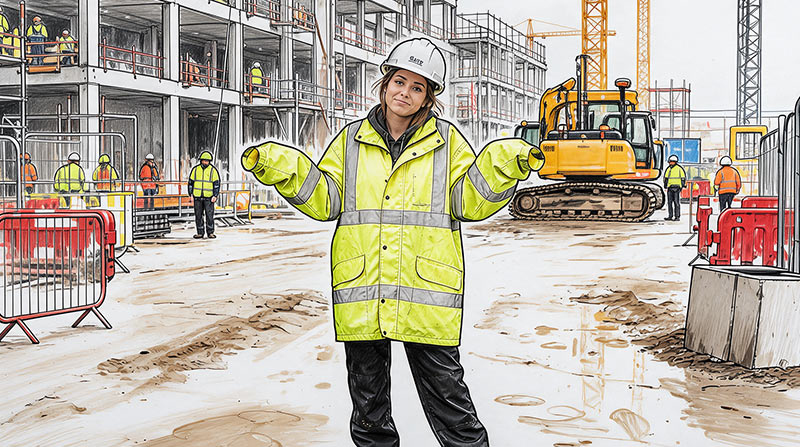
For decades, protective equipment has been built around an "average" male body. The result is a workforce wearing kit that slips, snags and gets in the way, and a safety risk that rarely shows up in the accident book.
Ask almost any woman working in construction, engineering, manufacturing or utilities about her PPE and you'll hear a version of the same story: Boots half a size this way or that, gloves that won't grip, a harness that sits wrong, a jacket that has to be rolled up at the cuff... Not a great start to anyone's day.
It is usually framed as a comfort issue. It isn't.
46% of British women issued with PPE or a uniform say it doesn't fit them properly.
Poor fit is a safety failure, not an inconvenience
PPE only works at the point of contact. A glove that's too large removes the grip it was bought to protect, and the smallest glove on the market is still too big for the majority of women's hands. Oversized boots become a trip hazard on scaffold and ladders. Loose sleeves and excess fabric around a rotating machine are an entanglement risk. Respiratory protection that can't achieve a face-fit seal offers a false sense of protection rather than real protection.
There's a second cost that's harder to measure. People who can't do the job comfortably work around the equipment: pushing goggles up, taking gloves off for fiddly tasks, leaving a jacket unfastened. Every workaround is a control that has quietly stopped working. And for employers fighting to recruit and retain skilled people, kit that signals "this job wasn't designed with you in mind" does real damage.
What the law already requires
This isn't a new obligation dressed up as a trend. The Personal Protective Equipment at Work Regulations have always required PPE to be suitable, and suitability explicitly includes fitting the wearer. Since April 2022, that duty extends beyond employees to limb (b) workers, which captures a large share of the contract and agency labour common in our sectors.
In other words: issuing a smaller version of a man's glove and calling it compliance has never really met the standard.
What's changed
There is now practical guidance to work from. BSI has published BS 30417, Provision of Inclusive Personal Protective Equipment, which sets out how to specify, buy and issue PPE that accounts for gender, body shape, ethnicity, age and disability. It is free to download, and it builds fit into every stage of procurement rather than treating it as an afterthought at handover.
The issue has also reached Parliament, where MPs have argued for inclusive PPE standards to be written into public procurement, which would move this from good practice to a condition of winning work.
Four questions worth putting to your own business
- Does the PPE we issue actually fit the people wearing it, and how do we know, beyond assuming that a size label is enough?
- Are women offered properly designed options, or just smaller versions of men's kit?
- Can someone raise a fit problem without feeling they're being difficult or holding up the job?
- Do our procurement decisions weigh fit alongside price and lead time, and do we ask suppliers to evidence it?
Where to start
You don't need a full programme to make progress. Ask your workforce directly what doesn't fit and log the answers, most organisations are surprised by the volume. Review one category at a time, starting with gloves and footwear, where poor fit does the most immediate harm. Then put fit into your supplier conversations as a specification, not a preference.
At ISB Group, we think this conversation matters because it goes to the heart of what PPE is for. Equipment that doesn't fit isn't protecting anyone, it's just being worn. If you're reviewing your own PPE provision and want a second opinion on where the gaps are, we're happy to talk it through.
Talk to us about your PPE provision.
Get in touch with us to review what you're issuing, who it fits, and where it's falling short.
Click here to view our range of Women specific products.
Sources and further reading



 Posted 18 Sep 2026
 1
1